
In the Media
We fear that legislatures are gridlocked and performative, rather than focused on actually passing new laws. But some legislators are consistently more effective than others, at the state and national levels. Can we train legislators to be more effective at advancing their bills? Mackenzie Dobson finds that training programs for state legislators don't make them more effective than their untrained colleagues. Most of the factors that make legislators more effective are structural: the competition between the parties and the positions they hold.
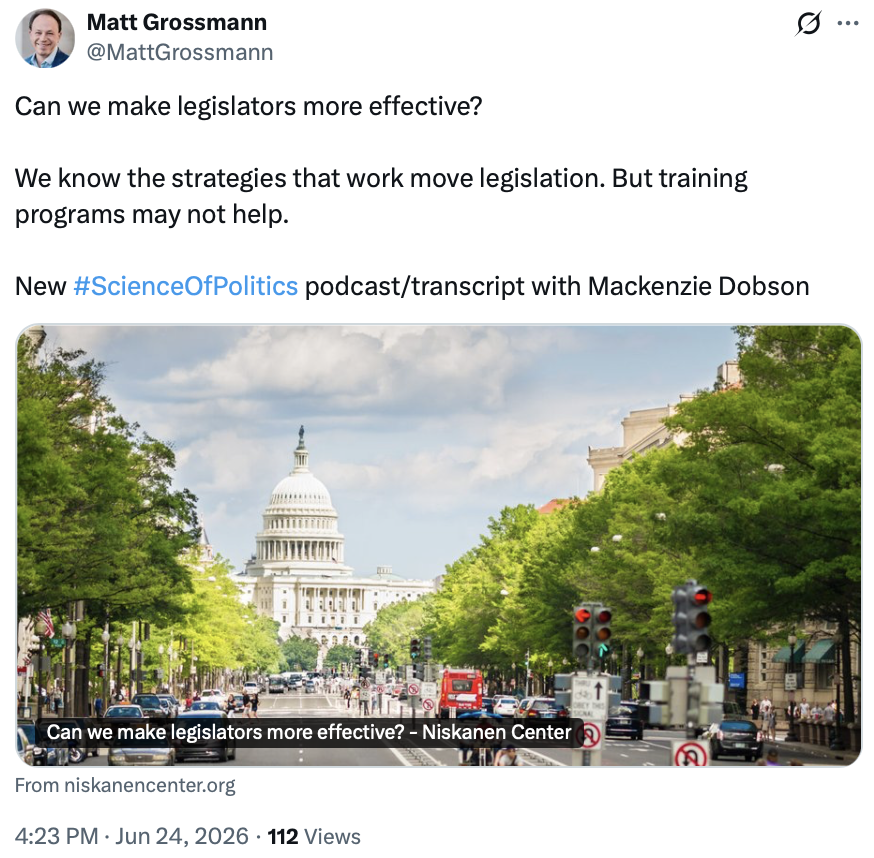
Apple Podcasts Spotify SoundCloud TranscriptMatt Grossmann shares the Science of Politics podcast on X
Matt Grossmann shared the episode on X, highlighting Mackenzie Dobson's research on what actually makes legislators effective. Dobson finds that training programs don't move the needle — structural factors like party competition, majority security, and institutional position shape who gets bills passed far more than individual skill-building.
 View Post
Congressional Bipartisanship Scores by Member and Issue Area, 1983–2024
The Center for Effective Lawmaking featured the Congressional Bipartisanship Scores project, a dataset developed with Jacob M. Lollis that measures how members of Congress attract and offer cross-party support across time and policy areas.
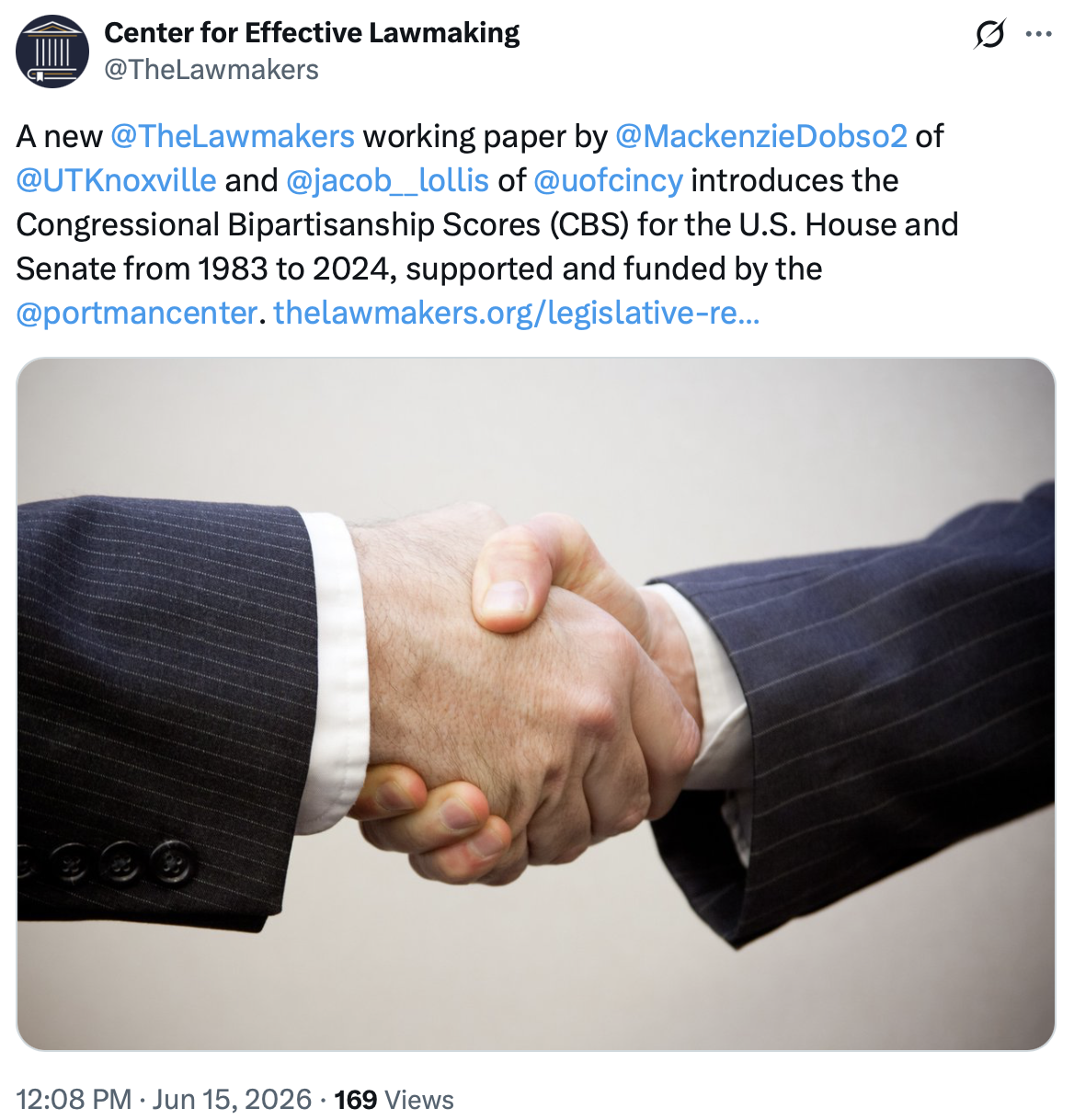
Read FeatureCenter for Effective Lawmaking shares Congressional Bipartisanship Scores on X
The Center for Effective Lawmaking shared the Congressional Bipartisanship Scores project on X, introducing the dataset co-developed with Jacob M. Lollis of the University of Cincinnati, supported and funded by the Portman Center.
 View Post
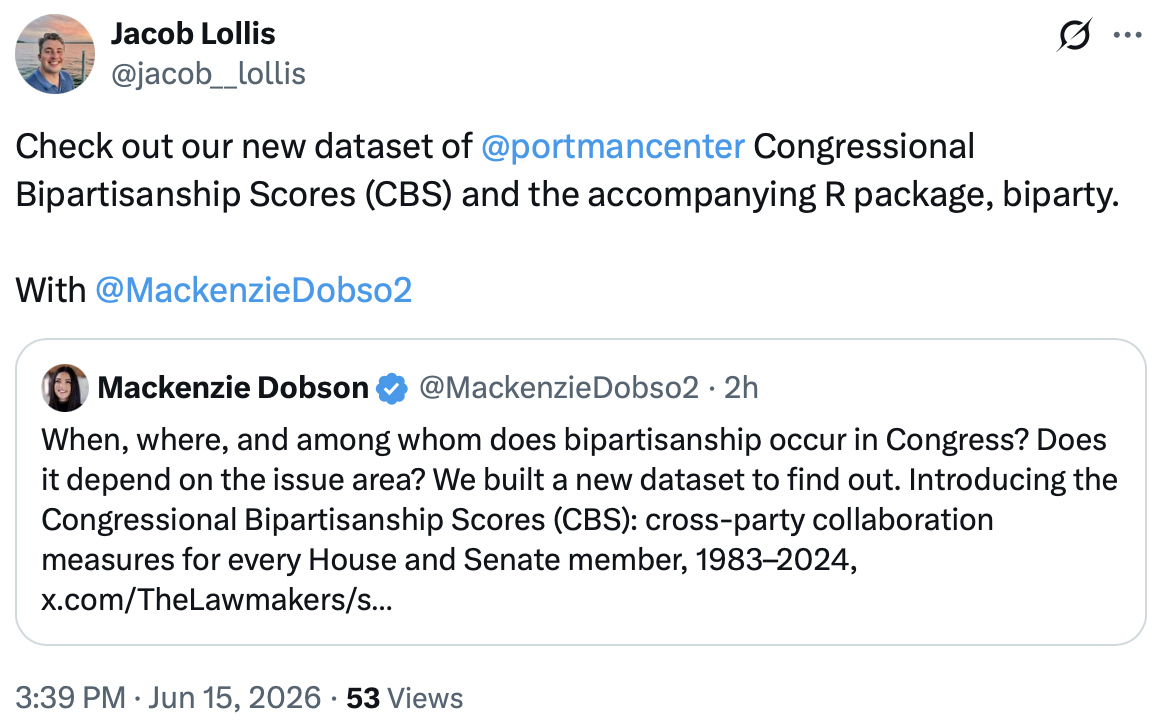
Congressional Bipartisanship Scores shared on X
Jacob M. Lollis shared the Congressional Bipartisanship Scores dataset and accompanying biparty R package on X.
 View Post
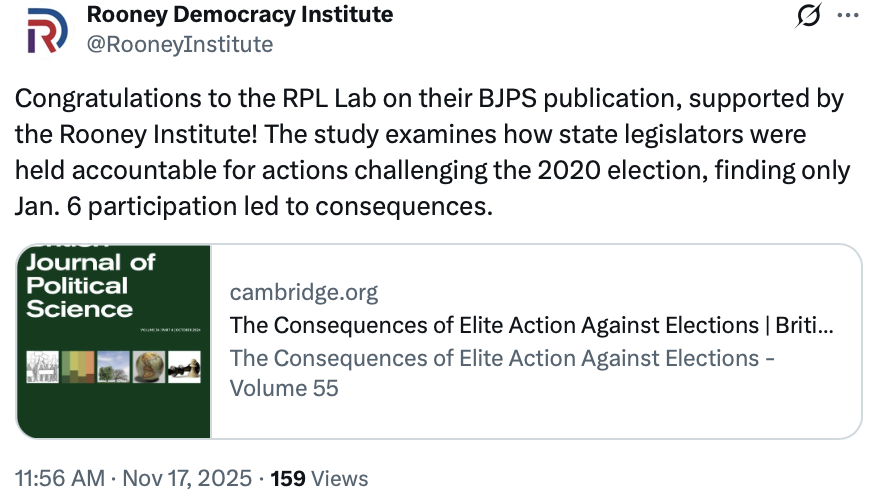
Rooney Democracy Institute highlights election-denying accountability research
The Rooney Democracy Institute featured the coauthored publication of The Consequences of Elite Action Against Elections in the British Journal of Political Science, which finds that only January 6th participation led to meaningful consequences for state legislators.
 View Post
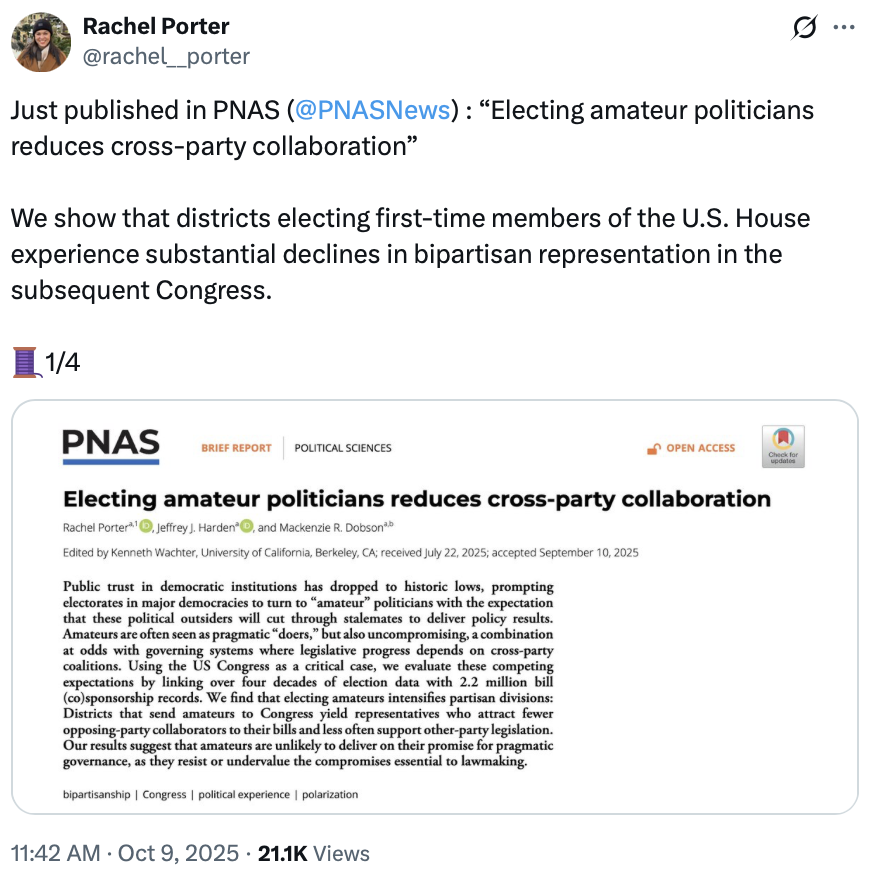
Electing amateur politicians reduces cross-party collaboration shared on X
Rachel Porter shared the coauthored publication in PNAS on X, which finds that districts electing first-time members of the U.S. House experience substantial declines in bipartisan representation in the subsequent Congress.
 View Post
Read Paper
View Post
Read Paper
The Consequences of Elite Action Against Elections featured in Good Authority
John Sides featured this research in his Good Authority newsletter, discussing findings from this coauthored work: Republican state legislators who participated in the January 6th "Stop the Steal" rally faced lower vote share, fewer cosponsorships, and less party funding, while online statements and offline actions showed no such penalty.
 Read Feature
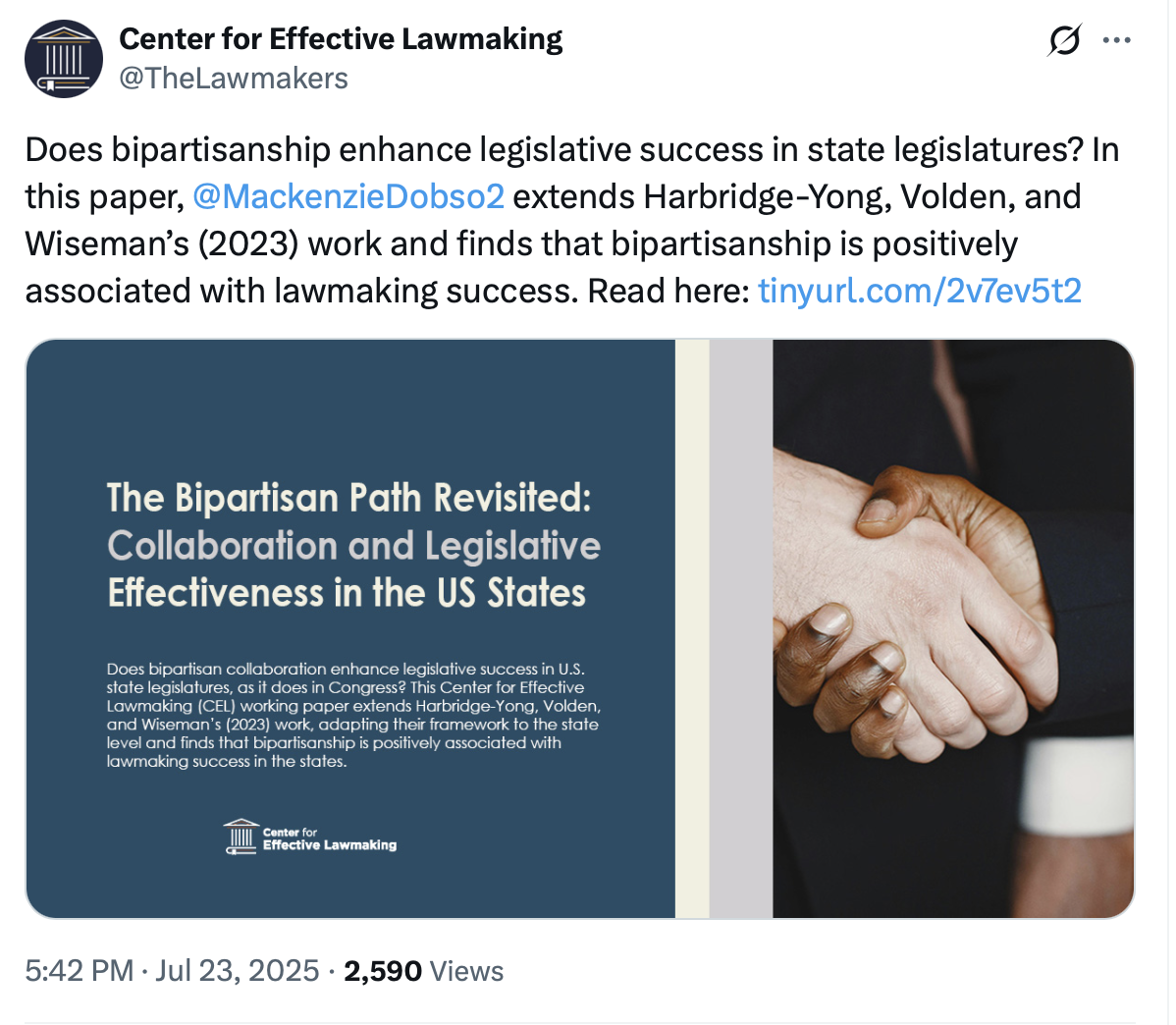
The Bipartisan Path Revisited: Collaboration and Legislative Effectiveness in the U.S. States
The Center for Effective Lawmaking featured this working paper extending Harbridge-Yong, Volden, and Wiseman's (2023) framework to state legislatures, finding that bipartisanship is positively associated with lawmaking success across 43 state legislatures.
Read FeatureThe Bipartisan Path Revisited shared on X
The Center for Effective Lawmaking featured Mackenzie R. Dobson's research on the conditional relationship between bipartisan collaboration and lawmaking success in state legislatures.
 View Post

Outcome-Consequential Campaigning
Read Feature
I'm Coming Out! How Voter Discrimination Produces Effective LGBTQ Lawmakers
Read Feature